A well-designed retail fitout should reflect your brand, support best practice in retail layout, and help create a smoother shopping experience for your customers. From customer flow through to product visibility, good design plays a big role in how a store performs, but every business is different, which means there is no one-size-fits-all solution. In the digital world, heat mapping is widely used across ecommerce websites to track user behaviour, improve user experience, and increase conversions. That same thinking can also be applied to brick-and-mortar retail. By showing how customers move through and interact with a physical store, heat mapping gives businesses an added layer of data to help guide smarter decisions around layout, displays, and future improvements.
To make those changes count, it is also important to have the right fitout partner who can properly bring new ideas and layout strategies to life in the physical space. Good retail design is not just about planning on paper. It needs to be executed in a way that suits the brand, supports the way the store trades, and gives the business flexibility to keep improving over time.
Understanding How Customers Move Through a Store
Before looking at the data, it helps to understand a few of the basics behind customer movement in retail environments.
When customers first enter a store, they usually need a moment to take in their surroundings. This entry area is often referred to as the decompression zone. It is not always the best place for key products or important promotional messaging because customers are still adjusting to the space.
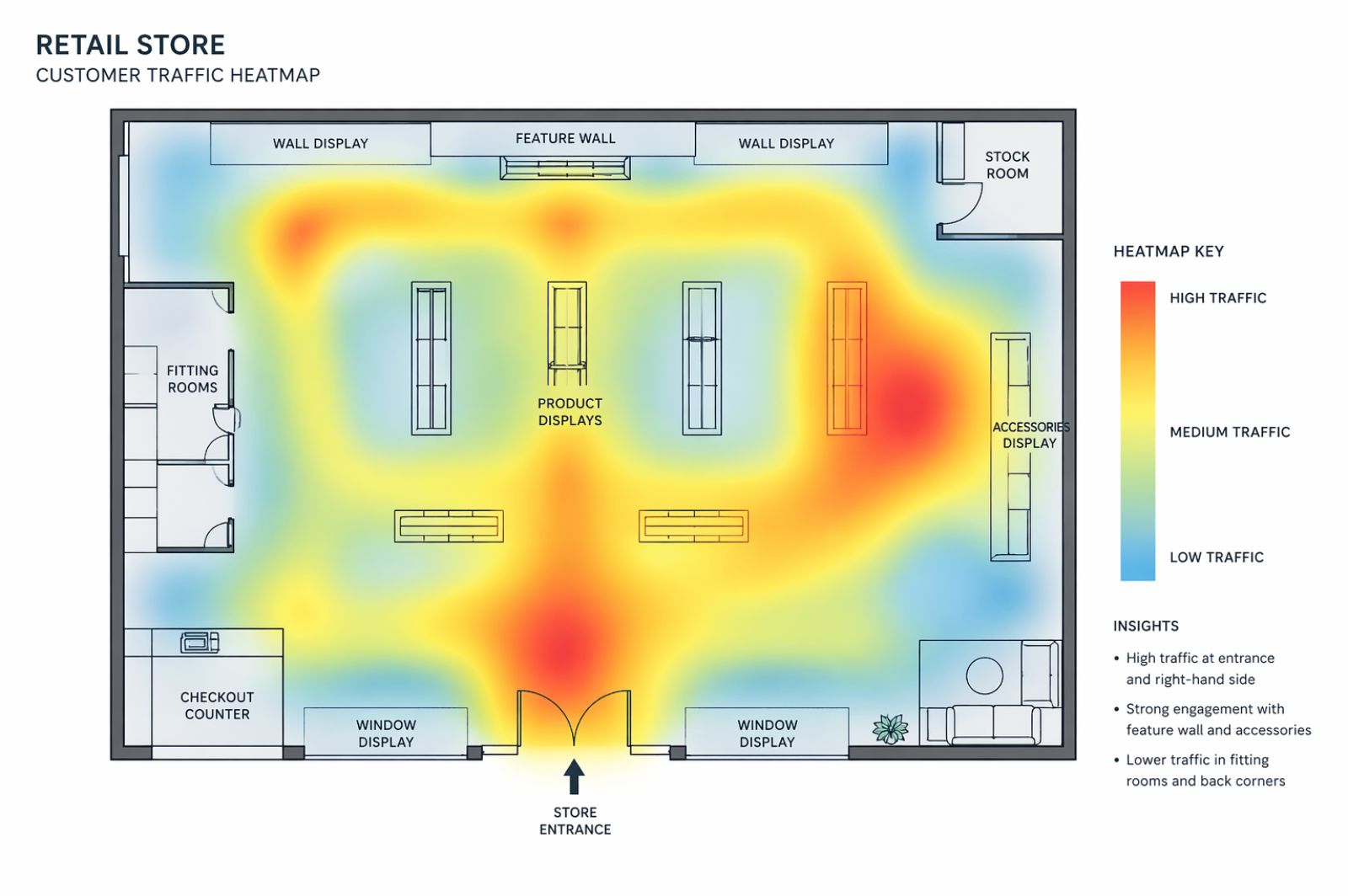
Many retailers also work around what is often called the invariant right, which is the tendency for customers to turn right when they first enter a store. This can make the front right-hand side of the tenancy a strong position for featured products, promotional displays, or key brand messaging. When planned properly, this area can help create a stronger first impression and guide customers more naturally through the rest of the store.
Store layout also plays a major role in how easy and enjoyable the shopping experience feels. Aisles that are too tight can make customers uncomfortable and disengage (the butt-brush effect), while poor flow can cause shoppers to miss entire sections of the store. In retail, layout is never just about fitting products in. It is about guiding movement and making the space easy to shop.
What a Retail Heat Map Shows
A retail heat map is a visual tool that shows how customers move through a store. It usually displays high-traffic areas in warmer colours and lower-traffic areas in cooler colours.
This information can be collected through in-store systems such as CCTV-based analytics, people-counting technology, or other movement-tracking tools. The goal is to understand patterns such as where customers are walking, where they are stopping, and which parts of the store are being overlooked.
For a retailer, this can be extremely valuable. It gives a much clearer understanding of how the shop is functioning in real life and whether the layout is supporting the way people actually browse and buy.
Benefits Of Using Heatmapping Technology
- Better insight into how customers move through the store
- Clearer identification of hot spots and underused areas
- Improved product placement based on real customer behaviour
- Smarter layout decisions to support customer flow
- Better understanding of where customers stop and engage
- Stronger promotional and display positioning
- Easier testing of new layouts, displays, or store concepts
- Improved ability to spot bottlenecks and problem areas
- More informed decisions around fitout changes and merchandising
- A better shopping experience for customers
- Greater potential to improve conversions and store performance
How Heat Maps Can Improve a Retail Fitout
Heat mapping can help retailers make smarter decisions across several areas of a store.
Better Product Placement
If certain products are not getting enough attention, heat map data can show whether the issue is the product itself or simply where it has been placed. Moving products into stronger traffic areas can improve visibility, while placing high-demand items in quieter parts of the store can help draw customers deeper into the space.
Stronger Promotional Zones
Heat maps can also show whether a display or promotional area is doing its job. If customers are walking straight past it, that may point to an issue with location, layout, sightlines, or presentation. This gives retailers the opportunity to make changes that improve engagement.
Improved Customer Flow
A good retail fitout should help customers move naturally through the space. Heat maps can reveal bottlenecks, dead zones, and areas where customers are hesitating or turning back. This can lead to layout changes that improve flow, reduce congestion, and create a better shopping experience.
Smarter Layout Decisions
When making changes to a store, it helps to have clear feedback on what is working and what is not. Heat maps make it easier to compare layout changes over time and see whether adjustments are improving customer movement and supporting better results.
A More Effective In-Store Experience
Once retailers know where customers naturally stop and spend time, those areas can be strengthened further through design choices such as lighting, displays, signage, and product presentation. In many cases, small improvements in the right place can have a strong impact on the overall customer experience.
Heat Maps Need to Be Used Properly
As useful as this technology can be, it also needs to be used responsibly. Retailers need to be mindful of privacy obligations and make sure any tracking or analytics tools are compliant with the relevant requirements.
The strongest approach is to focus on overall movement patterns and aggregate data rather than collecting personally identifying information. When used properly, heat mapping can provide valuable store insights while still respecting customer privacy.
Turning Store Data Into Better Retail Spaces
A retail fitout should not only look the part. It should work well for the people using it every day.
Visual heat maps help retailers understand how customers interact with a space once the doors are open. That insight can then be used to improve layout, strengthen product placement, refine traffic flow, and create a store that performs better overall.
For retailers planning a new fitout or looking to improve an existing store, heat map data can be a useful tool in making practical layout decisions that support both the customer experience and the commercial performance of the space.
Creating Retail Spaces That Work Harder for Your Business
If your business wants to test new retail ideas, promotional concepts, or layout changes, RJR Shopfitting can help bring those ideas to life with custom fitout solutions built for your space. From bespoke displays and feature zones through to full retail refurbishments, we work with businesses to create practical, well-built environments that support better customer engagement and stronger in-store performance. It is all about giving you a retail space that is not only functional and on-brand, but also flexible enough to evolve as your marketing and merchandising strategy grows.